FORWARD VISION
- Nannette Brown
- Jan 7
- 6 min read
Manifesting The New Year
Ah, this word manifestation. Whether manifesting your dream kitchen, your dream job or your dream relationship. It’s lofty. Maybe even overused. For some, it’s an empowering notion; for others, it’s vaguely woo-woo. Is it New Age—or simply of this age?

Whatever it is, it points to something undeniably true: our lives tend to move in the direction of our attention. Where the conversation falls short isn’t in manifestation as intention, but in its execution—the mechanisms that move an idea beyond inspiration and into lived experience.
Manifestation is often perceived as something we must think hard about to attract. In reality, its most powerful form lies in how we direct it—what we do with it. This distinction between desire and outcome is where forward vision begins: not with wishing or waiting, but with the disciplined ability to see ahead so that your present thoughts, habits, and decisions begin organizing themselves around what comes next.
MANIFEST
Let’s strip the word down. To manifest something is simply to make it real—to turn an internal idea into an external result. Nothing esoteric. Just translation: thought into decision, decision into behavior, behavior into pattern, pattern into outcome. In this sense, we’re manifesting all the time. The only question is whether we’re shaping that process deliberately—or letting it be shaped for us.
This is where manifestation is often misunderstood. It’s framed as attraction, when the real mechanism is direction. But good habits alone aren’t enough either. Sustained attention shapes what you notice, what you choose, and what you repeat.
When you change your orientation—what you’re open to, willing to consider, or prepared to act on—you change everything. Not just the passive idea of willpower used to “attract” an outcome, but your habits as well. Because you change your exposure. New information appears. Different people enter the frame. Opportunities that were previously invisible come into view—not because they were sent to you, but because you were finally positioned to see them.

Life Architecture is simply the applied version of this. It’s the deliberate design of the conditions that shape you: your thinking, your routines, your environment, your inputs. No major moves required—just openness to positive experiences and change. Over time, it alters your field of possibility.
Life forms around what you practice—and what you make room for.
PAPER IT
Written Words

There’s a reason writing things down works—and it has nothing to do with motivation. When you put a goal on paper, you externalize it. You force specificity. You turn an abstract desire into something seen, something instructional.
Decades of behavioral research—from Harvard Business School to the American Psychological Association—show that clearly articulated goals, especially those written down, dramatically increase follow-through, not because the outcome is wanted more, but because the path becomes clearer.
What writing does not do is produce outcomes on its own. The act isn’t symbolic, and it isn’t transactional. Writing works because it changes how you think and behave. It sharpens attention, exposes gaps, and turns intention into something you can see—something you can return to and respond to. Without that next step—action—it remains a plan, not a result.
There’s also growing evidence that how you write matters. Writing by hand engages deeper cognitive processing than capturing ideas digitally. The slower pace forces synthesis rather than transcription—reflection rather than reaction—which strengthens comprehension, memory, and clarity.
The most effective written goals share a simple quality: they don’t stop at what you want—they’re specific, including how and when you’ll act. Clear goals paired with written plans—decisions made in advance—remove friction at the moment of choice.
In architectural terms, a written goal becomes a working drawing: something you can reference, revise, and build from. Forward vision doesn’t require constant inspiration. It requires clarity that’s practical.
THE BEST BLUEPRINT
Is The One That’s Right For You
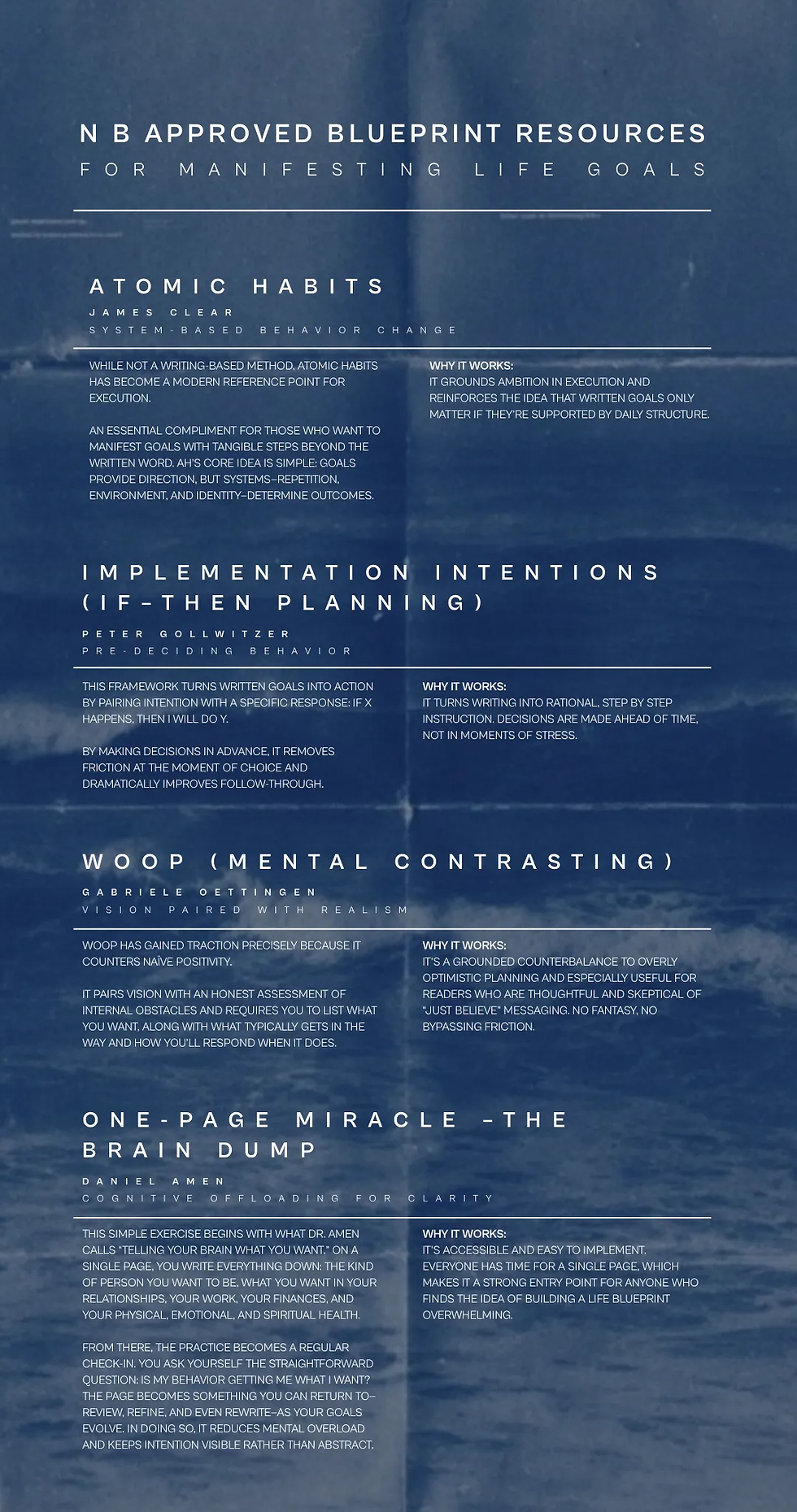
Designing a blueprint means deciding how you’ll move from intention to execution. That blueprint might come directly from trusted thought leaders—psychologists, behavior experts, self-growth coaches—or it might be something you design yourself. More often than not, it’s a combination. What matters is identifying what’s ideal for you.
Some people work best with a single, clearly defined system; others borrow the strongest elements from a few and adapt them over time. The point isn’t which framework you choose, but that you choose something that helps frame your thoughts and goals—and that you can refine as you go.
I’m very visual, so something that’s laid out structurally, sensibly—like a blueprint—has always appealed to me. Clear visuals create clarity of action.
I’ve looked at various frameworks over the years, and I’ve found the following resources to be most compelling because they’re effective at translating thought into behavior. Different in style but similar in substance, each offers a practical way to move from vision to execution.
BRAIN FOOD
Language, Rehearsal, Conditioning

Once the blueprint is clear, the next variable is mental material. It’s what you feed your brain that’s critical. And what you repeatedly tell yourself matters—literally and structurally. Language, in all its forms—written, spoken, even self-spoken—shapes perception. And perception shapes behavior.
Instructional self-talk strengthens follow-through; destructive self-talk erodes it. The effect isn’t instantaneous, but whether positive or negative, it builds over time—compounding into either formative, supportive feedback or unhelpful, even harmful, playback.
This is where affirmations are often misunderstood. They’re treated as corny, playing-card declarations (and they can be), rather than conditioning exercises. Saying something once does very little—especially if the words don’t mean something specific to you.
In fact, affirmations don’t have to be cards. An affirmation process can be an inspiration board, notes, clippings, or quotes—anything that resonates and directly supports your goals. The aim is repetition: returning to something meaningful often enough that, when paired with action, it reinforces identity and expectation.

An affirming, consistent practice of confirming a forward vision isn’t about blind positivity, pretending things just happen, or denying that challenges exist. Affirmations (seriously, this word needs a rebrand) are really about entering a state of mental rehearsal. What we practice consistently is what we become, whether we realize it or not.
On that same note, eliminating mental junk food matters just as much as cultivating constructive internal language. Constant diets of distraction—continuous digital consumption, endless scrolling, low-grade and poor-quality inputs—make sustained vision difficult.
This isn’t about withdrawal from real life or denial; it’s about discernment. You cannot feed your mind noise and expect clarity. What you allow in becomes part of the structure you’re building.
WHERE VISION MEETS MOMENTUM
Vision isn’t a moment of clarity. Manifestation isn’t just wishful thinking. Both are practices. It’s the repeated act of seeing where you’re headed and letting that awareness inform what you do today. This isn’t daydreaming. It’s constant rehearsal, returning to a future state often enough that decisions begin aligning with it naturally.
Consistency is what gives vision weight. You don’t redraw the blueprint every day, but you reference it constantly. Small, repeatable actions compound. Over time, they create stability—and stability is what allows growth to hold. Forward vision doesn’t require an early January burnout. It requires simple, daily steps that provide continuity.
This is also where myths around manifestation go sideways. Writing something down doesn’t make the world respond. The universe doesn’t deliver on cue. What changes is you—your attention, your choices, your tolerance for distraction, your willingness to act. That’s the mechanism. That’s the magic.
ONE AND THE SAME
Vision Shapes The Future

Manifestation, stripped of excess language, is not about attracting what the world gives you. It’s about architecting the conditions, the environments that shape your outcomes. Blueprinting your goals. Feeding your vision daily. Acting with purpose. Architecting an outcome.
Likewise, forward vision doesn’t deny complexity, constraint, or difficulty. It’s not about blind belief or avoiding obstacles. It’s about accepting reality and the conditions that come with life, while recognizing that we still have agency over outcomes and our day-to-day lives—a choice to direct rather than drift.
When challenges arise—and they always do—your cultivated vision is there if you’ve laid the groundwork, acting as a backstop, cemented into your psyche and guiding how you move through them.
Life doesn’t happen to you. It happens because of what you repeatedly think, choose, and reinforce.
In the world of Life Architecture, you’re not just imagining a future. You’re building it.It’s construction. There’s nothing woo-woo about that.


Comments