YOU ARE WHAT YOU WEAR
- Nannette Brown
- Apr 28
- 11 min read
If You Know, You Know.

You can say a lot of things about fashion, but one thing is undeniable: we all engage with it on some level. Whether you love it, follow the seasons, know the major houses, watch the runways, track street style—or couldn’t name an up-and-coming designer if your life depended on it—you still wear clothes.
And clothes, at their core, are driven by two things: utility and fashion. Which has always fascinated me, because it’s really not either/or. It’s more of a spectrum. As I write this, that Eric Clapton song—It’s in the way that you use it—keeps popping into my mind. And I suppose for good reason. That’s precisely the point.
Clothes serve a purpose. But like so many things in ourselves and in culture—and at the core of why I love Life Architecture—there’s always meaning beyond the superficial.
With clothing, we’ve become far more aware of what that purpose can do beyond function. We’re starting to understand how what we wear affects how we feel, how we think, and how we land—from our mood and mindset to our performance in everyday life.
At the same time, fashion itself has expanded. Never before have we seen such a confluence of fashion and pop culture. It’s a real moment. Fashion is integrated into everything—from films and music to sporting events, consumer brands, and, in a full-circle way, back to utility and workwear.
The lines are blurred. And I think that’s great. High and low. Utility and streetwear. Function and expression. Fashion today can be almost anything—and increasingly, it is. It’s become the fabric of everyday life, literally.
It makes it fun, aspirational, yes, but much more attainable too, because there’s no barrier to entry. At any price point, new or old, what you wear becomes part of your personal brand and language—something that can only be expressed by you.
Which is exactly why getting your head around what you wear matters more than ever. It’s one of the most effective personal tools in your self-to-self and self-to-world toolkit—one that, when understood, can shape not only how you feel, but how you operate at your highest level in both your personal and professional life.
Fashion is only superficial if you wear it that way. But, it has potential to mean a lot more if you’re simply thoughtful about it. I place it in the same category as striving for personal excellence. And that has to start somewhere.
ORIGIN STORY
Family, Function, And Work Wear

Don’t forget, clothing didn’t begin as fashion. It began as necessity.
If we go all the way back, the earliest garments were created for protection—for warmth, for survival, for labor. Materials were chosen for durability, not aesthetics. Animal hides, woven fibers, simple construction.
As civilizations evolved—ancient Egypt, Greece, Rome—clothing began to reflect hierarchy and identity. Tailoring improved, textiles expanded, trade influenced style. And by the time the industrial revolution rolled around, dress codes were formed and what we now recognize as fashion began to take shape.
But here’s the important part: utility never disappeared. It simply evolved.
I’m from Tennessee, where farming and house painting were a real part of both my grandfathers’ lives. Even my father, who went on to become a businessman, was raised on a farm, never really leaving his love of land—or his Carhartts—far behind.

If you don’t know Carhartt, it’s a 137 year old American workwear brand designed for durability and function. My uncles, who are now house painters too, wear them to this day. You can go to the farmer’s supply in town and buy them.
Carhartt is a perfect example of why we may think utility and fashion have nothing to do with one another. But they do.
The second utility leaves its original context—off the farm or job site and into a different environment—it starts to morph into something more cultural. What was once purely functional begins to carry a different kind of meaning.
Today, Carhartt has become such a force in pop culture they operate in two lanes. There’s the original utility line, and then there’s Carhartt WIP (Work in Progress), which sits squarely inside fashion–and it’s moving fast.
I’ve even come across reworked Carhartt at vintage sales—most recently one at the old Barneys location downtown. Same garment. Different context. And a completely different audience.

And Carhartt isn’t alone. Brands like Dickies, Levi’s, Timberland, and Patagonia have followed a similar path—all originally built for utility, then absorbed into culture, and reimagined through style.
That’s the nature of fashion. It interprets. Which is why it’s nearly impossible to avoid. It’s uniform and costume both and it exists in everyone’s lives— even opting out is still a statement.
So the real question isn’t whether clothing matters. It’s how much it matters to you.
IT’S NOT INGOGNITO.
It’s Enclothed Cognition.
And it’s good for your head. And other stuff too.
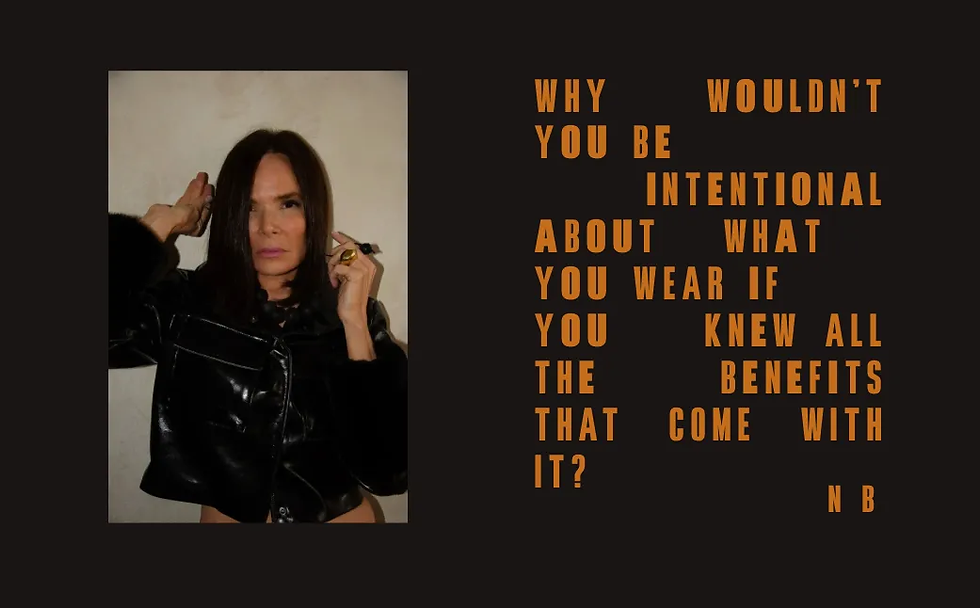
So, yes, if you knew what you wore had the potential to change you, and potentially the opportunities and outcomes in your life, wouldn’t you want to embrace at least some part of it?
There’s research with some pretty compelling reasons why you might say yes.
It’s called “enclothed cognition,” and it’s based on a study that found that what you wear affects how you mentally process things. The findings also found that clothing changes how others perceive you, but that was the least of it. The study’s biggest take-away was that it changes us, including how we think, feel, and perform.
The findings identified two key factors: the symbolic meaning of the clothes and the physical experience of wearing them. In other words, it matters not only what you wear, but what that clothing means to you while you’re wearing it.
This is why clothing can feel transforming at times. Not because fashion can solve your life, but because clothing can help shift your state of mind. Clothing can virtually place you in a desired state.
Clothing can give you shape when you feel scattered, authority when you feel uncertain, softness when you need ease, or polish when you need to perform. It can change your posture, your energy, your confidence, and the way you enter a room.
I love Barbara Corcoran’s story she shared on The Mel Robbin’s Podcast last week. She said the moment she earned her first paycheck she went out and bought a great coat. She literally spent every dime of it and said she had zero regret because it gave her the confidence to walk into any room after that—and that feeling was more valuable than any paycheck.
There’s also a professional reality here, and we should be honest about it. Appearance and grooming are linked to earnings, especially for women.
A 2016 study found that attractive individuals, those who were ‘well groomed’ earned more than their colleagues, and that grooming, including clothing and presentation, play a measurable role in how people are perceived economically. And in turn, how they’re promoted.
Stereotypical, yes. But it’s real and it underscores the point that presentation is an extremely strong form of communication. We may not like the rules, but denying they exist doesn’t help either. Understanding them gives us agency.
So no, getting dressed is not trivial. It is a tool. It’s your edge. And, in many ways, it’s your home court advantage.
THE POP CULTURE OF FASHION
Shaping The Zeitgeist

In pop culture terms, fashion is at the intersection of pretty much everything today. It’s everywhere.
And it couldn’t be at play more than this week. There are two big fashion events happening and one is coming to a theatre near you with the re-make of the original cult classic, The Devil Wears Prada. This Friday, The Devil Wears Prada 2 comes out.

And the 2026 Met Gala takes place on Monday, May 4th. The Costume Institute’s theme this year is “Costume Art.” Vogue will livestream the event across its digital platforms, YouTube, and TikTok, which tells you everything you need to know about where fashion lives: in the museum, on the carpet, on our phones, and in the comments section all at once.
Fashion is woven into every corner of pop culture. Of course The Devil Wears Prada is literally about fashion, but every film has a costume designer ensuring visual language be told as part of the story as well.
Major designers and stylists are also on tour and red carpets constructing the public images of everyone from Beyoncé and Taylor Swift to Billie Eilish, Zendaya, Lenny Kravitz, Timothée Chalamet, the Kardashians and more—
These creatives are an entirely new class of celebrity driving visual story telling through their clients, their projects, and themselves. They’re masters at crafting image as architecture. Clothing as character development.

And big companies like Starbucks are in on it too. For the Devil Wears Prada 2 they’ve created a secret menu inspired by the film’s characters. That may sound absurd, or fun, or both, but pop culture it is.
Fashion is no longer confined to runways, magazines, or department stores. It spills into coffee, streaming, memes, red carpets, airport photos, Substack, TikTok, and the way a person throws on a barn jacket to walk the dog.
And in Manhattan this week, art, fashion, and the zeitgeist converge for the Met Gala. This first Monday in May event delivers big on both fashion and cultural theater. What began as a museum benefit has become a global media event, dissecting fashion, celebrity, and social maneuvers in real time. Editors, creators, fans, critics, and anyone with a phone have front-row seats. The fashion isn’t just seen. It’s judged, explained, memed, and monetized before the night is over.
But the more interesting point is that fashion’s visibility across media has changed the way we participate in it entirely. We no longer consume fashion from pages or from afar. We vote on it, share it, remix it, reject it, and shop versions of it almost instantly.
THE FASHION TIMES
The Social Star Is Born

Fashion magazines were our bibles for decades. They told us what mattered, what was coming, and had a heavy hand in determining what we’d want. Fashion was seasonal, more controlled, more filtered. Designers designed. Editors distilled. Photographers gave us fantasy, and models became our muses. They were the celebrities—the first influencers—guiding the style we followed.
I wish fashion could exist equally between both worlds. There’s still nothing like the tactile pleasure of a glossy magazine in your hands, the saturated photography, the physical excitement of buying an issue and disappearing into it. But today, a phone can deliver more images in five minutes than a magazine ever could. Sadly, it rarely delivers the same sense of immersion.
Still, culture moved. Digital media didn’t just change how fashion was distributed. It changed who held power. The system that once moved fashion from designer to editor to model to consumer has become an entirely different ecosystem.
Street style influences designers. Vintage influences luxury. TikTok influences retail. Fast fashion compresses seasons. Influencers drive sales. A 17-year-old with a ring light and good, or even questionable taste, can move product faster than an editorial spread.

This has created more access, more diversity, and more room for people of different ages, sizes, budgets, and backgrounds to influence style. That part is thrilling. You can build an audience by having an eye.
But there’s also a downside. When everything is content on a 24-hour social cycle, style can become frantic. The pace is relentless. Trends come and go so quickly that I often wonder if we’ll remember them.
And it’s not likely to change because influencing is serious business. The fashion influencer marketing market was valued around $6.8 billion in 2024 (latest stats) and is projected to grow even more dramatically by 2030.
The creator economy continues to reshape brand momentum across industries with beauty and fashion representing the most powerful categories.
Another slight downside: fashion can become less about taste and more about reaction. How many likes—-and sooo many young women and men dressing the same. I really believe the real skill now is discernment.
And here’s the irony. Technology may have changed the fashion landscape, but it hasn’t changed the human element of style. AI can help brands forecast demand, produce imagery, generate campaigns, or even create digital models, but real fashion is still driven by human taste. We follow people because of the way they see, and the way we see them. The eye is the asset.
MY FAV INFLUENCERS
Driving The Fashion World

I love fashion, but I also love the psychology and culture around it. I can get pretty nerdy about the social science of it all, especially as it relates to taste, confidence, and personal identity. I see it as part of us: what we say to the world, yes, but also what we say to ourselves.
Also, I’m a voyeur. I love watching people. There’s nothing better than seeing what someone is wearing, how they pull things together, how they make it their own. I love how a woman or a man can take something ordinary and make it suddenly feel entirely specific or unique. The compositions of shape, color, and the way people combine pieces constantly amaze me.
Here are a few social accounts I follow. Some are great for style. Some are great for curation. Some are terrific for reviews. Generally, they’re all good resources.
My favorites organized by style inspo, resources, and current events/news:

Inspiration:
Michal Kurtis IG: mkurtis
Neelam Gill IG: neelam.ahooja
Lauren Santo Domingo IG: thelsd
Resources:
Olivia Wayman IG: oliviasshoppingdiary
Marina Didovich IG: marina_didovich
Kate Klem IG: katyaklema
Current Events/News:
Derek Blasberg IG: derekblasberg
The Business of Fashion IG: bof
Women’s Wear Daily IG: wwd
My top, top, top fashion influences are the ones I’ve mentioned before. They are, and remain, Amal Clooney, Zendaya, Nicole Kidman, and Kelly Wearstler.
Honestly, there are so many incredibly fashionable women out there, most of whom aren’t even celebrities, but these women simply speak to my own sensibilities. I always love knowing who speaks to everyone else, too.

I touched on stylists above, but a few really have to be given proper credit for styling some of these women. Zendaya’s longtime stylist Law Roach IG: @luxurylaw deserves big accolades– what he’s done with image-making is genius.
And I can’t recall the last time Nicole Kidman made a misstep on the red carpet. I had the pleasure of sitting next to her a few years ago at the Oscar’s and she, along with her dress, sublime. And she was so nice! Her stylist, Julia von Boehm IG: @juliavonboehm is also fantastic, especially for red carpet looks.

Posthumously, I still love Carolyn Bessette-Kennedy (for some continuing inspiration there’s always IG @cbk_closet) and Jackie Kennedy. Love them both for their restraint, polish, and clarity of style.
All of these women demonstrate the difference between wearing clothes and having style. Clothes are the easy part. Style takes intelligence, thought and creativity. And when combined—you never have to say a word. Your carriage communicates all.
PERSONAL TASTE & STYLE
Fashion As Self Architecture

This is where fashion becomes Life Architecture. Dressing isn’t about vanity, unless you make it that. It’s about self-construction. It’s intentional.
We’re all, in some way, building ourselves daily—through our routines, our homes, our food, our friendships, our work, and yes, our clothes. What we wear can either support the person we’re trying to become or keep us tethered to a version of ourselves that becomes stagnant, never grows, or no longer fits.

Celebrity stylist Erin Walsh, whose book The Art of Intentional Dressing comes out in May, is the woman behind Anne Hathaway’s red carpet looks for The Devil Wears Prada 2. She frames the morning question of how to dress beautifully in a different way.
Instead of asking only, “What am I going to wear?” she asks, “How do I want to feel?” She then suggests choosing three words that describe how you want to feel for the day. As simple as it sounds, it moves clothing into meaning, which is exactly the connection the enclothed cognition study links to better performance.
And then there’s the topic of your home closet:
A good closet is not necessarily a large closet. It is an honest one. It tells the truth about your body in that moment, your life, your taste, your ambition, your comfort, and your standards. It should give you viable options without confusion. It holds beauty, utility, memory, and discipline all in one.
That’s why editing your closet is a necessary task, but sometimes an emotional one. You’re not just getting rid of old clothes. You’re confronting old selves. The fantasy self. The smaller self. The younger self. The self who thought discomfort was sophistication. The self who was waiting for a different life to begin.
When you look at fashion through the lens of personal style, it begins to frame better questions. What do I reach for when I need to feel strong? What makes me feel like myself? What’s here because it’s aspirational, or tied to who I used to be?
These are not superficial questions. They are architectural ones.
IT’S ALL YOU
Be Your Own Cool Girl

Fashion is everywhere—on screens, carpets, runways, feeds, films, and even coffee cups. But the most important place fashion lives is much closer to home. It’s the most important relationship, and that’s the one you have with yourself.
It’s in the small but mighty stuff, like the daily decision of how you choose to meet yourself before you meet the world.
You don’t need to be obsessed with fashion to benefit from it. You don’t need to buy more, follow every trend, or dress like someone else. In fact, the opposite is true. The more saturated everything becomes, the more powerful it is to know who you are and what works for you.
That’s what makes it all you.
So yes, you are what you wear. More than you know.



Comments