THE AGE GAME
- Nannette Brown
- Mar 31
- 8 min read
Do You Play?

I can tell someone’s age in under five minutes—or at least get pretty close—and it has nothing to do with how they look. It’s how they talk, what they reference, what they watch, what they listen to—even how they move. I glean so much within moments of simply listening and observing.
This is especially true around my contemporaries, people in middle age—40s to 60s. Not everyone wants to look younger for youth’s sake, and I understand that. But I’m often struck by how many people my own age carry themselves—and think—in ways that feel older.
Maybe it’s because we define age as one number, and then define ourselves by it. Or maybe it’s values—different priorities, different goals. Not everyone wants to live to one hundred, or strength train in midlife either.
But the truth is, few people think they act older—and yet many do. We frame ourselves, and then we live within those frames.
Me? I don’t believe age is one number. It feels far more dimensional than that. And if you really want to know someone’s age—the kind that actually defines them—I believe the real tell is something else entirely.
It’s your cultural age—the way you assimilate the world around you, adapt and evolve with it in real time.
Yet we have to acknowledge the obvious ways we age, because they do matter. I’m just not so sure they matter equally.
AGE DEFINERS
The Standard Three

If we’re going to talk about age with any clarity, we have to start with the traditional framework—the three ways we define it. These are the markers we default to most:
Chronological age is the least interesting. It’s fixed, non-negotiable, and tells you very little about how someone actually lives.
Biological age is the one with consequences. It reflects how well you’ve taken care of your body—and the rate at which it’s aging.
Subjective age is where things get nuanced. It’s how old you feel, and more importantly, how you think—which, somewhere around midlife, becomes the one we identify with most. It’s also how you operate based on that sense of self.
This is where the age mind game begins. I really believe when you stop identifying with a number, you start identifying with your state. And that state either keeps you engaged and evolving—or quietly pulls you back, suggesting you’ve already missed your moment.
Don’t let time pass you by.
CULTURAL IQ > AGE
The Real Tell

This one is the biggie—the one rarely mentioned, the most telling, and for me the most fascinating: your cultural age.
Cultural age is the measure of how current you are—revealed through what you consume, what you understand, and what you’ve chosen to adopt. We create our biases, and then we live within them—including stereotypes about younger generations, our world views, and even how old we think we feel.
Here’s the thing. If we’re not living in the present—referencing it in real time, or at least fluent in contemporary culture—we’re out of step. Whether it’s technology and AI (and no, basic ChatGPT use is not adoption), or knowing the defining voices of our time across disciplines, mediums, and platforms—if you’re not engaged, you’re stalled. That’s your cultural IQ and it’s the age-teller.
It shows up in the details. The length of your texts. The size of your font. The blare of a ringtone in a quiet room. The voices you follow—Alex Cooper, Joe Rogan, Rick Rubin, Scott Galloway, Ezra Klein, Ira Glass—or none at all. Individually, these things aren’t a big deal. Collectively, they place you in a moment in time.
If you’re not aware of a wide variety of cultural markers, you’re not evolving—you’re fixed.
This isn’t just about habits. It’s about how you engage with the systems shaping modern life:
social media, podcasts, live formats, dating apps—-even how and where you work—are the evolving ways we communicate and consume information. These are the new norms. The older rails may feel more comfortable, but they won’t keep you current.

And it’s all in plain sight—your conversational references, your taste, your awareness. Whether younger ideas feel legible to you, or completely out of reach. It’s your relationship to technology—whether you’re facile with it or have integrated new tools like AI agents into your daily work flow —or keep postponing them.
But more than anything…

The world doesn’t stop. And it certainly doesn’t wait for us to catch up. It moves—quickly, constantly—and we decide how we meet that pace. Some resist it. Some observe it. And some adjust in real time. I try to be the latter.
This isn’t about appearing current. It’s about maintaining the capacity to change.
That ability to adjust, to recalibrate, is psychological as much as it is practical. Assimilating to the times requires constant curiosity and a desire to learn; it also requires a certain humility. Admitting that I don’t know the sum of all I’ve already learned, despite years of wisdom I’d like to think I’ve acquired.
It’s the willingness to get closer to what you don’t know. To update your thinking. To let go of what no longer applies and start to understand what does.
That’s at least how I see it.
N. B. M.O.
Age Is Analog. Just Re-Coded.
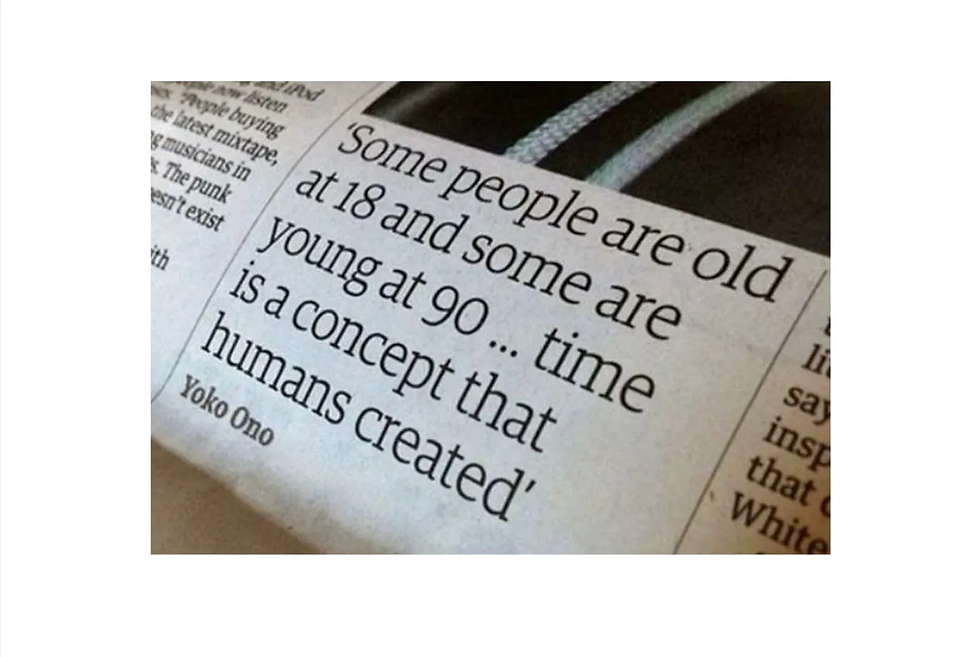
I’ve come to realize that whatever this is—this sense of moving through life without a fixed idea of age—is something I’ve always felt. I was always mature beyond my years growing up, so perhaps I adopted a strong sense of self at an early age. I never let age hold me back then—and I try not to now.
What is it? That I’m just young at heart? I honestly don’t think so. I’m actually a serious person—it’s not about reliving my youth. It’s something else. It’s about being in step with the world. With now.
I think it’s curiosity. I’ve always been an avid learner, constantly assimilating new tools, new ways of living, thinking, and working. Curiosity touches everything in my world, from relationships to work. It shows up in the way I edit, write, and structure a sentence. In how I communicate—shorter, cleaner, faster for work, and more carefully, more deliberately in a relationship. I’m in a constant state of refinement, whether consciously or not.
And when I fall behind, I feel it immediately. If it’s something like AI or a new way of working, I move toward it—even if it takes time. I learn it, use it, or move on if it’s not useful.
I seek out new voices constantly—writers, thinkers, podcasts, music. My Spotify age is that of a 22-year-old. True—which has to be a mistake, because my musical taste is far more sophisticated than that…or at least I’d like to think so!
I also love discovering new cultural voices across all kinds of genres. My podcasts taste ranges from conversational hosts to world affairs, business and health leaders —from Alex Cooper to Bryan Johnson and Ezra Klein—all feel energizing, not disjointed.

And then there’s health. Exercise isn’t optional—it’s education. It’s accepting what science is teaching us about how our bodies age. It means embracing the hard stuff—strength training, sprints, discipline—while allowing for balance. Doing enough to matter. Enough to stay aligned. And knowing the difference, while still enjoying life.

I see all as a responsibility to my future—to extend my health span and the quality of my life.
I’m even defiant about certain markers. I’ll live with smaller text. Avoid loud ringtones. I make choices that keep me in step with today’s cultural norms. Everyone I work with is young—and besides, I have boys. They would roast me for not having basic phone prowess.
I invest in my body—beauty, supplements, wellness. I’m thoughtful about my choices, but also embrace protocols and products I think work.
And yes, I’m open. To ideas, to experiences, to change. I’ve explored things that some might question—injectables, PRP, laser treatments. Even psychedelics—though I don’t love feeling out of control, so my experiences have been measured, more about self-exploration than anything else.
I believe my openness is what makes me adaptable.
I want to be able to move through every stage of life with ease—to understand what’s shaping it, what’s driving it, what tools define it—and to be able to speak to it. Not just as an observer, but as a participant.
BALANCING ACT
Appropriateness

There’s always a conversation around age appropriateness—but it’s rarely clear. It sits somewhere between outdated rules, social expectations and perception. But, what we’ve all come to learn is that perception isn’t reality.
To me, it’s about calibration. Self-awareness. Knowing what works, what doesn’t, and why.
This is where age, taste, and self-perception intersect. What we wear and how we present ourselves are deeply personal, considered choices. For a long time, these were tightly defined norms—standards that held across ages and genders for generations, but they especially existed for women.
That’s changing.
The people who get it right aren’t ignoring appropriateness—they’re just redefining it. Pushing just enough to make something their own.
Even what I’m doing now sits slightly outside the expected lane. Life Architecture—design, home, cooking, self—layered with ideas that push beyond a traditional design lane and into something more expansive, even a bit provocative. Our campaigns. The way I’m portrayed. At this stage of life, that might be unexpected. But that’s the point.
It’s not about rejecting the norms. It’s just about knowing them well enough to sculpt them and move beyond the edges, even while respecting certain aspects of them.
When things are done right, they’re rarely inappropriate.
THE UPSIDE
To Thinking Young
There’s a reason changing your way of thinking matters. People who think younger and take steps to reduce their rate of aging tend to live younger. They stay curious, active, and involved.

That engagement carries into everything. When you’re mentally present, you’re more likely to take care of yourself, stay connected, and keep moving.
And we know this much to be true: people who consistently stay active—physically and mentally—tend to live not only better, but longer. Movement, strength, recovery, even things like sauna and disciplined routines—all have an impact on longevity, and more importantly, health span.
So while mindset is key, it’s not mindset alone that adds years. It’s that mindset, the desire to grow, improve, stay relevant, drives behavior. And behavior—how you move, how you care for your body, how you stay engaged—has very real consequences over time.
SEIZE THE MOMENT
It’s Time. Time Matters

There’s never been a better time to get this right. The old ideas around aging are dissolving. People are hitting their stride later—and better. There’s far less rigidity around how we’re supposed to age.
But time still matters.
With that openness comes a choice—whether to stay engaged or step back. Whether to remain curious or settle into what’s comfortable and familiar.
The opportunity is there—but it requires intention. A willingness to stay in it.
And when you do, age stops feeling fixed. It becomes something you move with.
What else are we going to do? Life moves. We either ride with the brakes on, accelerate, or at the very least cruise.
I say accelerate full speed ahead.
THE MODERN AGE
Living In Real Time
When I step back and look at all of this, it comes down to something super simple.

Age isn’t a number. It’s a reflection of how aware—and how invested you are—in your life and in the world. It’s what you pay attention to. What you’re willing to learn. How open you are to change. It’s the way you care for yourself, how you step up to a challenge, and whether you make a decided choice to keep evolving.
I don’t think about being younger. I think about staying aligned—with what’s happening, with how I want to live and with who I am as the world evolves.
Maybe that’s the point. Not to chase time, but to stay in flow with it, while remaining true to yourself. It takes just enough intention, awareness and quiet force—to remain relevant. Afterall, isn’t that what we all want?
Hey Millennials, Gen X, Baby Boomers—whatever you do, change your ringtone. It’s a dead giveaway.
Don’t let your age define you.



Comments