HOW TO LEAD A MENTALLY RICH LIFE
- Nannette Brown
- May 19
- 6 min read
True Well-Being

We spend a lot of time trying to achieve the holy grail of a well-lived life: career, family, friends, the house or perfect apartment, the wellness routine, even downtime. All feel like qualifiers in the balancing act of success.
But here’s something that surprised me.
Did you know that women report higher life satisfaction than men, probably the highest they’ve ever experienced, yet worse mental health at the same time?
The men don’t fare much better. Research shows men consistently overestimate their well-being. Apparently, they think they’re doing better than they actually are.
It turns out nobody is accurately feeling their lives. Particularly well, at least.
Something really important has shifted in the past few years. And we’re getting honest about it. It’s our mental health picture.

Mental well-being has finally stepped out of the shadows, losing the stigma that once kept it private. It’s taken its rightful place alongside physical health as a real, studied pillar of how we live. We track sleep, stress, and state of mind the way we once tracked only steps and calories.
Now that we’re getting a real look at the data, it’s both surprising — and not.
The biggest takeaway we’re beginning to understand? The gap between how a life looks and how it actually feels is wider than most of us expected.
WHEN YOU BUILD YOUR HOUSE
Don’t Forget the Lights

We’ve gotten extraordinarily good at building things. But it turns out, we’re still best at constructing exteriors.
Careers. Homes. Bodies. Wardrobes. Calendars. Yes, all those qualifiers for a good life, even the visible architecture of a well-organized, well-curated one, we’ve mastered them. And yet, for a remarkable number of high-achieving, seemingly fulfilled people, something still feels off. Like the house is beautifully designed, but the lighting isn’t quite right.
In a really interesting study, researchers Shigehiro Oishi and Erin Westgate put a name to it a few years ago, and it’s one I think will resonate: psychological richness.
I’d never heard of it, but I love everything it means and it turns out to be an important part of our make up. In fact, it’s considered the third dimension of well-being, distinct from happiness and distinct from meaning. It’s the psychological nuance, texture, and layers in our lives. It’s the inner world that expands us.
And it’s the one we know the least about because it requires design.

A psychologically rich life isn’t necessarily the calmest life. Or even the happiest one. More often, it’s a life filled with experiences, ideas, beauty, fascination, emotional texture, and moments that alter the way you see things.
Psychological richness comes from being deeply engaged with life, not just simply comfortable inside it. It grows through curiosity, reinvention, creative pursuits, deep conversation, art, books, music, travel, cultural exposure, and encounters with different kinds of people and ways of thinking.
And here’s something we can all relate to—often, it’s built within the very moments that stretch us: risk-taking, contradiction, heartbreak, discomfort, recovery, and even failure.

Psychological richness is what gives us dimension. It expands our minds. It sharpens perception, deepens emotional range, and keeps life from becoming flat, even when outwardly successful.
ADDING THE SECOND FLOOR
Bringing Others Into The House And Upstairs

All these elements of life that require introspection and design also require something else: other people. Humans need humans. We need quality friends, community, and certainly interaction.
While the work starts inside us, we also need meaningful relationships, and that requires allowing others into our lives. That’s when we can genuinely build the richest one.
Here’s probably the most interesting finding on this:

The longest-running study of adult well-being in history, conducted at Harvard and comprising eight decades of data, says what matters most in life is not your career trajectory. Not your net worth. Not even your health habits, though those matter too. It’s the quality of your relationships at midlife.
So if you’re young, start now. The relational habits you build early, how genuinely you connect, how willing you are to let people in, compound over your lifetime and make meaningful friendships easier to build.
And if you’re at midlife, don’t worry, it’s never too late. You have something most twenty-five-year-olds don’t: you know people now. You’ve lived enough to know who’s actually worth letting in, and who isn’t. That kind of discernment is its own advantage.
Warren Buffett has often said the most important decision you’ll make in life is who you marry. He might just as easily have said: who you let upstairs, or into your head.
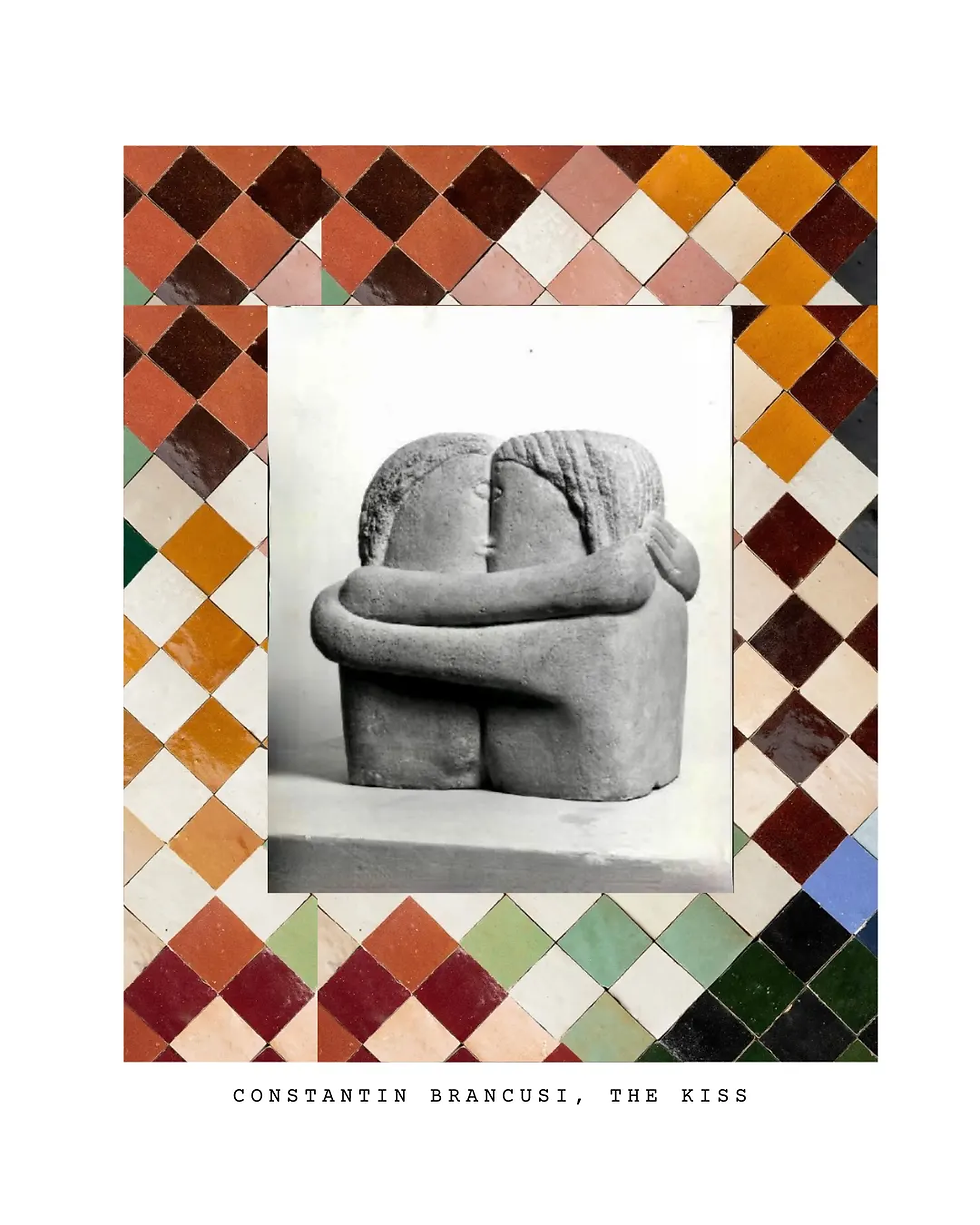
This single factor—the quality of your relationships today—is one of the strongest predictors of health and happiness in your eighties. And it’s not how many relationships you have, but how seen you feel by the ones that matter.
That’s an interior metric. Again, a design matter.
It might mean going less wide and taking the time to go deeper.
I say this because networking and socializing are important aspects of business, personal life, and friendship-building, but sometimes we focus on expanding the number of people we know, whether to get ahead or simply because we think we should, when perhaps we’d be better served deepening the relationships that resonate with us or show the potential to become something more.
The bottom line: the richness of a mentally well-lived life boils down to the quality of attention you bring to it.
That includes the depth of the relationships you tend and the richness of your inner experience. You have to keep working at it because, one way or another, it will show up unmistakably in how you feel inside a life that, from the outside, may look like it has it all.
THE MASTER PLAN
The Things Worth Building

If leading a mentally rich life is your goal, and I really hope it is, then these are the most important things worth learning:
Attention.
Where your attention goes, your life goes.

You can move through entire days, weeks, even years and not be inside a single moment of it. That’s not a productivity problem. That’s a richness problem.
The ability to actually be present wherever you are, to go deep in conversation or a piece of focused work, to deeply invest in a relationship, or even to truly take in a walk instead of merely going for one, is rarer than it should be. But more trainable than most people think too.
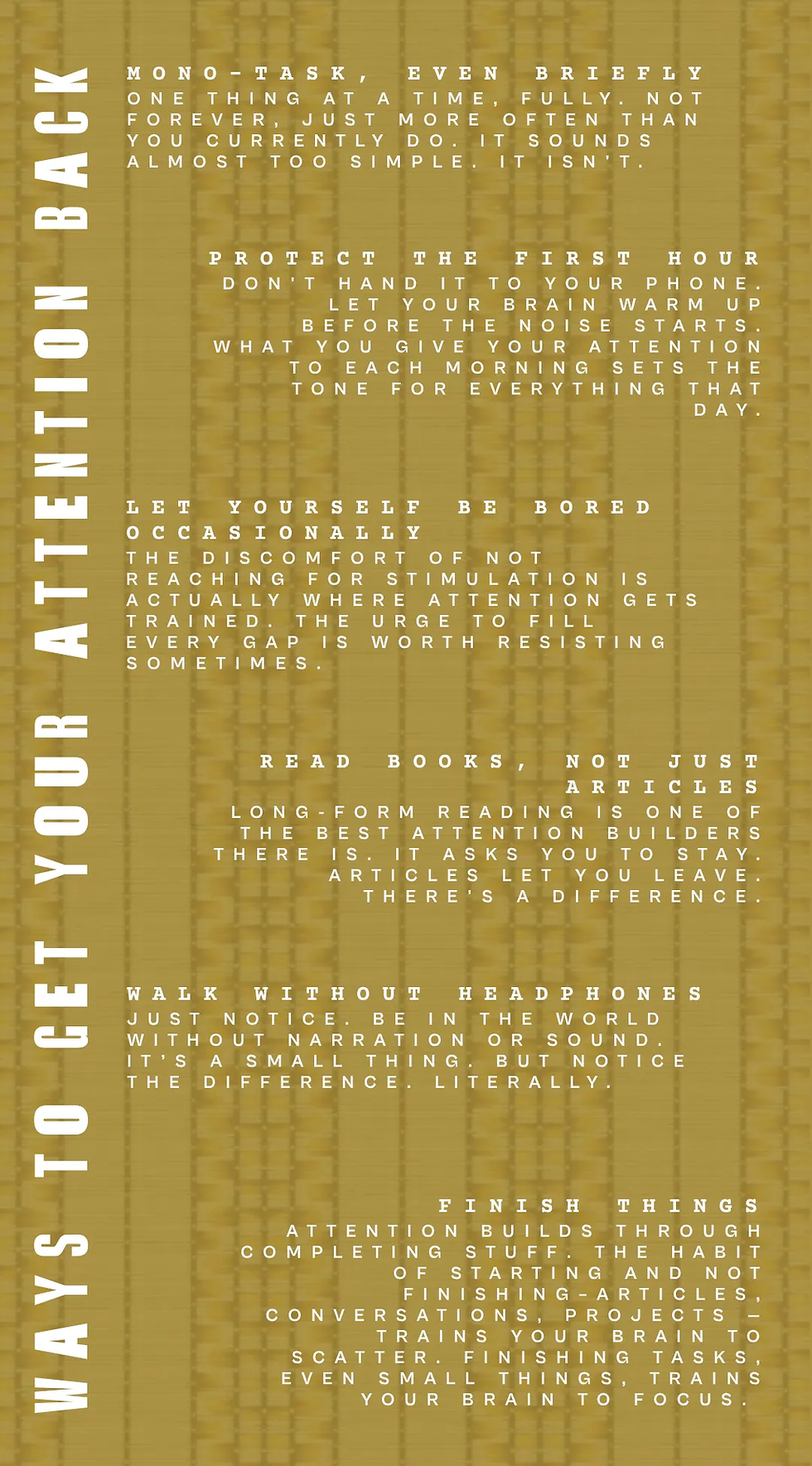
Treat your attention like a skill. It is one. And if your attention needs rewiring, these are ways to reel it back in.
Novelty.
Know the difference between novelty and stimulation.
Scrolling is mindless. A compelling conversation that genuinely shifts how you see something is new. A trip that makes you slightly uncomfortable, but transforms you, is new.
The difference isn’t the activity. It’s whether it questions or demands something of you. The experiences you actually remember, the ones that give texture to your life, that richness we’re looking for, almost always asked something of you. Seek more of those.
Who Knows You.
By that I mean—who really knows you?

Look at your closest relationships and ask honestly: do my family, my friends, my partner, actually know what’s going on with me? Not the version I know how to present. But, the real one.
If the answer is mostly no, that’s the renovation worth making. And arguably the most important one on this list.
YOU’VE JUST GOT TO ASK
The Way
Here are four questions worth sitting with if you really want to enrich your life and your mental well being.

They aren’t posed as a to-do list, but instead a way to cut through the noise. The kind a good friend might ask:
What is the ratio of consumption to creation in your daily life?
Where do you have genuine friction, not stress, but good friction — the kind that’s actually teaching you something?
Who in your life tells you things you don’t already believe, including a hard truth?
What have you let fade that used to make you feel alive, most like yourself?
Most people who read these already know the answers. Which means you probably do too. You just haven’t thought about them for a while.
If one of them hits harder than the others, start there.
A NEW STANDARD
For A Well Lived Life

What I’ve come to believe after years of studying and designing how people build their lives is that the missing piece is almost always the same: where your attention goes.
Whether you’re seeking experiences that actually change how you see the world. And whether the people closest to you really know you.
This is what determines how a life actually feels on an ordinary day, when no one is watching. And that, in the end, is the only measure worth designing a well-lived life around.
If something here stayed with you, a thought that gave you pause, a question you’re still sitting with, even a relationship you may now be thinking differently about, start there. That’s not a small thing.
It’s the whole idea behind leading a mentally rich life.




Comments